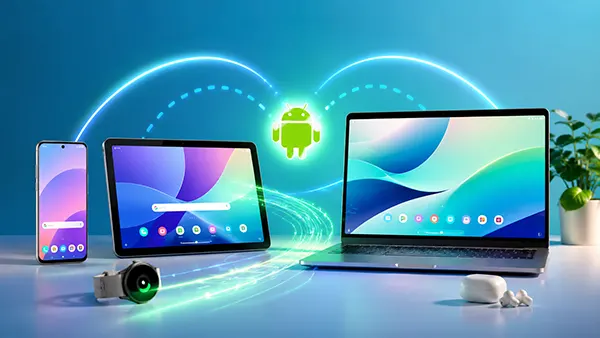
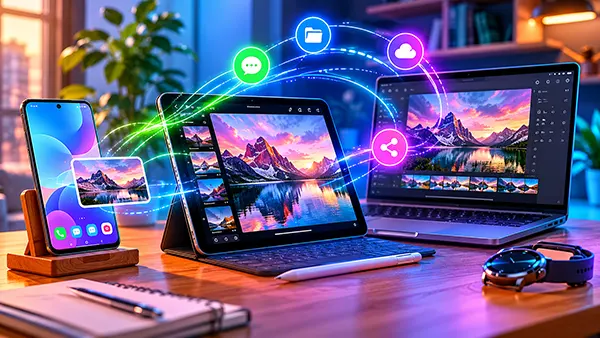
Android devices in 2026 are no longer isolated gadgets that operate independently from one another. Google is actively moving towards a connected ecosystem where smartphones, tablets, Chromebooks and Windows laptops exchange data, applications, notifications and active tasks almost instantly. The release of Android 17 and the development of the Continue On feature demonstrate how Android is evolving into a unified working environment rather than a simple mobile operating system. Users can now start editing a document on a phone, continue on a tablet and finish on a laptop without manual synchronisation or file transfers. This shift affects productivity, communication, entertainment and even security practices across personal and professional devices.
Android 17 and the Expansion of Cross-Device Integration
One of the most discussed Android developments in 2026 is the expansion of Continue On functionality in Android 17. Google introduced deeper task continuity between devices, allowing users to transfer app sessions between smartphones, tablets and compatible laptops with minimal interruption. Unlike earlier synchronisation tools that only copied notifications or browser tabs, the new system can preserve active app states, partially completed forms and media playback positions.
Android now uses a combination of Bluetooth Low Energy, local Wi-Fi discovery and encrypted Google account authentication to recognise nearby trusted devices. When a user opens a compatible application on another device, the system suggests continuing the same session instantly. Messaging apps, note-taking software, office tools and streaming services already support this feature across many manufacturers.
The development also reflects Google’s attempt to compete more directly with Apple’s ecosystem continuity features. However, Android takes a broader approach because it must support devices from Samsung, Lenovo, OnePlus, Xiaomi, ASUS and many other hardware companies. This creates additional complexity, but it also gives users more flexibility when building their personal ecosystem.
How Continue On Changes Everyday Device Usage
The practical impact of Continue On becomes visible in daily multitasking scenarios. A user can begin reading an email attachment on a smartphone during travel, switch to a tablet for editing and later open the same workspace on a laptop without searching for files manually. Android 17 reduces friction between screens by treating active sessions as transferable workflows rather than isolated app instances.
Another important improvement is clipboard synchronisation. Cross-device copy and paste now works more reliably between Android devices and ChromeOS systems. Images, links, formatted text and temporary notes can move securely between screens in real time. This is especially useful for remote work, education and content creation where users constantly alternate between multiple devices throughout the day.
Media continuity has also improved considerably in 2026. Users can transfer active audio streams, video playback or even gaming sessions between devices with reduced latency. Some applications now support automatic handoff when the system detects that the user switched to a larger display. This behaviour is becoming increasingly common in streaming platforms and cloud gaming services.
The Role of Tablets and Hybrid Devices in the Android Ecosystem
Android tablets have gained renewed relevance because cross-device functionality finally gives them a clearer purpose. Earlier generations of Android tablets often struggled to differentiate themselves from large smartphones. In 2026, tablets increasingly act as transitional productivity devices between phones and full laptops.
Manufacturers such as Samsung and Lenovo are investing heavily in hybrid Android workflows. Devices now support multi-window operations, desktop-style interfaces and dynamic app scaling that adapts automatically when users move between displays. Android 17 improves keyboard and stylus integration, making tablets more suitable for office tasks, illustration work and educational use.
Another major factor is the growing connection between Android smartphones and Windows laptops. Microsoft Phone Link and Google’s updated cross-device services allow users to mirror notifications, transfer files instantly, answer calls and access mobile applications directly from desktop environments. This reduces dependence on cables, third-party cloud storage and manual synchronisation tools.
Why Manufacturers Are Prioritising Ecosystem Features
Device manufacturers increasingly understand that long-term customer retention depends on ecosystem convenience rather than hardware specifications alone. Processing power improvements have slowed compared with previous years, so companies now compete through software continuity, cloud integration and connected experiences.
Samsung’s ecosystem strategy demonstrates this clearly. Galaxy smartphones, tablets, watches and laptops now interact through shared notes, synced browser sessions, connected audio switching and unified hotspot management. Similar strategies are visible from Xiaomi HyperOS, HONOR Connect and Lenovo Smart Connect systems introduced throughout 2025 and 2026.
Cross-device ecosystems also encourage users to stay within one brand family. Once people become accustomed to seamless task transfers and synchronised workflows, switching to unrelated devices becomes less attractive. This mirrors trends already established in other technology ecosystems, but Android manufacturers are attempting to offer more compatibility across different hardware categories.
Security, Privacy and the Future of Unified Android Systems
As Android devices become more interconnected, security concerns are becoming increasingly important. Cross-device communication involves constant data exchange between smartphones, tablets and laptops, which creates additional attack surfaces if not properly protected. Google has responded by expanding encrypted local communication and introducing stricter verification for trusted devices in Android 17.
Biometric authentication also plays a larger role in unified Android environments. Some systems now allow a smartphone fingerprint scan or face unlock to authenticate actions on connected tablets or laptops. This reduces password usage while maintaining stronger device-level verification. Google is additionally expanding passkey support to simplify secure sign-ins across multiple screens.
Privacy management remains a major challenge because cross-device continuity relies heavily on behavioural data and account-level synchronisation. Users must decide how much information they want shared between devices. Android 17 introduces more granular controls that allow separate permissions for clipboard syncing, app continuity, notification mirroring and media transfers.
The Direction of Android Ecosystems After 2026
Industry analysts expect Android ecosystems to move further towards ambient computing models over the next few years. Instead of users manually selecting which device to use, systems may increasingly predict workflow transitions automatically. Artificial intelligence will likely assist in deciding where notifications appear, which screen should continue a task and how applications adapt to different hardware.
Another expected development involves stronger integration between Android and wearable devices. Smartwatches, smart glasses and automotive systems are becoming part of the same connected environment. Google is already expanding Android Automotive and Wear OS compatibility with shared account sessions and synchronised contextual data.
The broader transformation is not simply about convenience. Cross-device Android systems are gradually redefining how people interact with computing itself. Smartphones are no longer standalone products but central hubs connected to multiple screens and interfaces. In 2026, Android is moving closer to functioning as a distributed computing ecosystem where hardware boundaries become less noticeable during everyday use.