When Hades first arrived on PC and consoles, it was praised for its tight combat loop, layered narrative structure and carefully tuned difficulty curve. By 2026, its iOS version has had time to mature, receive patches and adapt to Apple hardware evolution. The key question is no longer whether Hades is a great game in general, but whether its fast, precision-based roguelike design translates effectively to touchscreens and mobile play patterns. This review focuses on real performance, control responsiveness, optimisation, and long-term progression experience on modern iPhones and iPads.
Performance and Technical Optimisation on iOS Devices
On current-generation iPhones (A17 Pro and later) and M-series iPads, Hades runs at a stable 60 frames per second in standard mode, with optional higher refresh support on ProMotion displays. Frame pacing is consistent even during effect-heavy encounters in Elysium or Temple of Styx, where multiple particle systems, enemy projectiles and environmental hazards overlap. Thermal throttling is minimal during sessions under 40 minutes, which aligns with typical mobile usage patterns.
Load times are significantly reduced compared to the original console release. Thanks to NVMe storage and Apple’s Metal API optimisation, transitions between chambers are almost instantaneous. This preserves the rhythm of the roguelike loop, which depends on momentum and short downtime between encounters.
Battery consumption is moderate rather than excessive. On an iPhone 15 Pro-class device, a 45-minute run consumes roughly 18–22% battery at medium brightness with sound enabled. Lower-end supported devices show slightly higher drain and occasional minor frame drops in late-game encounters, but the game remains fully playable.
Visual Fidelity and Interface Scaling
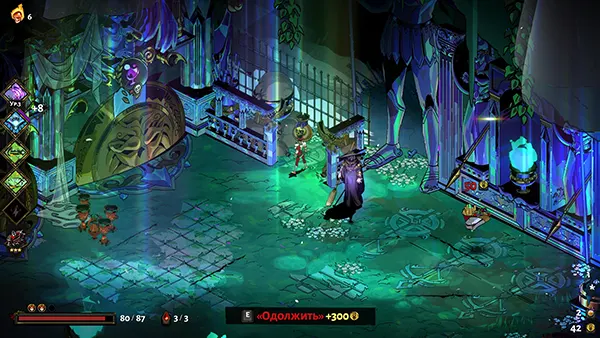
Supergiant’s distinctive hand-painted art style remains intact on mobile. Character sprites, environmental textures and UI elements are clean and sharp even on smaller screens. Importantly, the developers avoided excessive compression artefacts that often affect mobile ports.
The interface has been carefully reworked for touch interaction. Boon selection screens, Mirror of Night upgrades and weapon aspects menus scale properly across different screen sizes. Text readability is strong, even during handheld play outdoors, provided brightness is adjusted accordingly.
On iPad, the experience feels closest to the original console version. The larger display significantly improves spatial awareness during chaotic encounters, especially against Theseus and Asterius or late-game boss variants. Visual clarity directly affects gameplay precision, and tablet play offers a measurable advantage.
Controls: Touchscreen vs Controller Experience
The most critical challenge for any action-heavy roguelike on mobile is control precision. Hades relies on rapid dash-cancelling, attack chaining and accurate directional input. The iOS version offers two primary input methods: touchscreen controls and full controller support via Bluetooth.
Touch controls use a virtual joystick on the left and context-sensitive action buttons on the right. Basic attacks and dashes feel responsive, but advanced techniques such as dash-strike optimisation or tight positioning during boss mechanics require a learning curve. After several runs, muscle memory adapts, yet the experience remains slightly less precise than a physical controller.
Controller support transforms the mobile version into something nearly indistinguishable from console play. Latency is negligible, and input recognition is consistent. For players aiming to complete high-Heat runs, a controller is strongly recommended.
Accessibility and Customisation Options
The iOS build includes customisable button layout, adjustable HUD opacity and remapping options for controller users. These additions make extended sessions more comfortable and reduce accidental inputs during intense encounters.
God Mode, which incrementally increases Zagreus’ damage resistance after each failed run, functions identically to other versions. On mobile, this option is particularly useful for shorter sessions where repeated restarts might otherwise feel discouraging.
Haptic feedback has been subtly integrated. While not overly aggressive, it provides tactile confirmation during dashes, hits and Call activations. This small design decision improves immersion and helps compensate for the absence of physical button resistance when playing via touchscreen.
Roguelike Structure and Mobile Play Patterns
Hades is built around repeated runs that typically last between 25 and 45 minutes. On mobile, this structure aligns surprisingly well with real-world usage. The game supports mid-run suspension, allowing players to exit and resume without losing progress, which is essential for portable play.
The progression system remains compelling. Unlocking new weapons, aspects and Mirror upgrades maintains long-term engagement. Because the iOS version synchronises saves via iCloud, switching between iPhone and iPad is seamless. This continuity reinforces the “one more run” loop without fragmenting progress.
Importantly, the narrative delivery—voice lines, evolving relationships, and post-run dialogue—retains its impact. Audio quality is uncompromised, and using headphones significantly enhances the experience, particularly during emotional story beats in the House of Hades.
Long-Term Viability in 2026
By 2026 standards, Hades remains mechanically relevant. Its combat depth and build variety compete well with newer mobile action titles. Unlike many free-to-play releases, it offers a complete experience without monetisation layers interrupting pacing.
The absence of intrusive design elements means that the core gameplay loop stands on its own merits. Replay value comes from weapon mastery, Heat modifiers and narrative completion rather than artificial progression gates.
As a premium mobile title, Hades sets a benchmark for how console-quality roguelikes can function on handheld devices. While touchscreen controls introduce minor compromises, technical optimisation and full controller compatibility ensure that the essence of the original design remains intact.