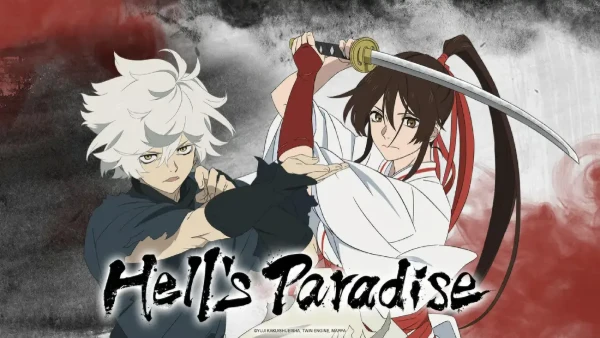
BATTLE IN HELL’S PARADISE brings Yuji Kaku’s dark fantasy manga and its anime adaptation to mobile devices through a survival-themed role-playing game developed and published by Good Smile Company. Released for English-speaking players in July 2026, the game follows familiar characters through Shinsenkyo, an island inhabited by dangerous creatures and powerful immortals. Rather than recreating the anime as a traditional action game, it focuses on assembling parties, developing characters and watching automated battles unfold. Its combat mechanics, original storylines and smartphone-friendly progression offer a different interpretation of the source material, particularly for players interested in character collection and tactical preparation.
How the Combat System Works in BATTLE IN HELL’S PARADISE
Combat in BATTLE IN HELL’S PARADISE revolves around forming a party of characters and preparing them for encounters against the island’s inhabitants. The roster brings together criminals, executioners and other figures from Hell’s Paradise, including Gabimaru, Yamada Asaemon Sagiri, Yuzuriha and Aza Chobe. Each character contributes to the team’s overall fighting potential through their individual abilities and development. Unlike action RPGs that demand continuous movement, dodging and manually timed attacks, this adaptation places greater emphasis on preparations made before a battle begins. Choosing suitable allies and improving their strength are therefore central parts of progression.
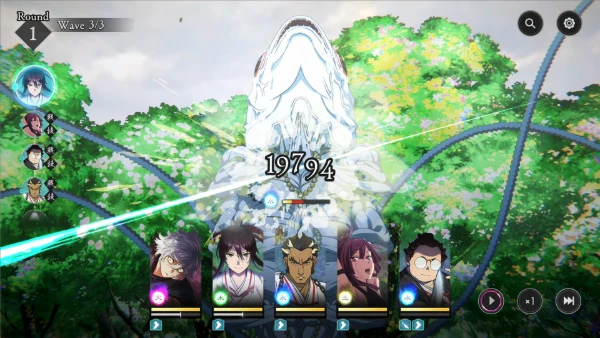
Once combat starts, much of the fighting is handled automatically. Characters perform attacks while the encounter plays out on screen, reducing the need for constant input. This approach makes battles accessible on smartphones, although it also changes the experience considerably compared with more interactive fighting games. Players expecting to control Gabimaru’s movements or manually execute every technique may find the system restrictive. The tactical element lies primarily in party composition, character development and understanding whether a particular group is adequately prepared for the opposition. Stronger enemies can expose weaknesses in a team that has progressed without sufficient attention to its members.
The combat presentation draws directly from the abilities established in the original series. Ninjutsu, Ittō-Ryū swordsmanship and Tao-based techniques appear as distinctive ultimate skills, connecting individual characters to their established fighting styles. Good Smile Company also involved MAPPA in supervising the game’s animation, helping maintain visual continuity with the anime. These special sequences provide much of the excitement during encounters, particularly when familiar characters perform recognisable techniques. However, the emphasis on automated fighting means that spectacle is not necessarily accompanied by extensive player control. The combat system is better understood as a character-focused RPG than a fully interactive action adaptation.
Party Composition, Character Abilities and Battle Preparation
Building an effective party involves more than selecting the most recognisable characters. Gabimaru’s ninjutsu, Sagiri’s swordsmanship and the distinct combat identities of other allies provide a useful starting point when considering a roster. The game encourages players to recruit and strengthen characters, making the development of several reliable allies worthwhile. A sensible early approach is to concentrate on the characters already available rather than repeatedly changing the entire party. This helps establish a dependable group for story encounters while leaving room to introduce newly acquired allies as the collection expands.
Character enhancement is particularly important because automated encounters offer limited opportunities to compensate for an underprepared team through manual skill. When progress becomes difficult, reviewing the strength of the current roster is more productive than simply repeating the same unsuccessful battle. Players can examine which allies need improvement, whether newly obtained characters offer better options and how available development materials should be distributed. Concentrating every resource on a single favourite may leave the rest of the party behind. A more balanced approach can make progression steadier, especially when several characters must contribute to the overall effectiveness of an encounter.
Ultimate skills also give combat a strong connection to the personalities and traditions of the original story. Sword techniques associated with the Yamada Asaemon executioners contrast with the ninjutsu used by shinobi and the supernatural powers present on Shinsenkyo. Their animated presentation helps distinguish characters even when ordinary battle actions require little direct involvement. This is one of the game’s clearest strengths as an adaptation: the fighting system preserves the visual identities of its characters without attempting to reproduce every movement from the anime. Players seeking detailed tactical control should nevertheless recognise that collecting, arranging and developing allies take priority over reflex-based combat.
Survival RPG Elements and the World of Shinsenkyo
The survival theme comes from the dangerous setting at the centre of Hell’s Paradise. Shinsenkyo initially appears to be an extraordinary natural paradise, but its beauty conceals grotesque creatures, supernatural threats and the powerful beings known as the Tensen. The original story sends condemned criminals and their executioner escorts to the island in search of the Elixir of Life. This unusual premise creates tension between characters who must cooperate despite conflicting loyalties. The mobile game retains that atmosphere through story encounters and battles against the island’s inhabitants, presenting survival as a continuing struggle to overcome increasingly threatening opposition.
Although the title is described as a survival RPG, its mechanics differ from those of conventional survival games built around hunger, shelter construction or open-world crafting. Its main activities centre on recruiting allies, strengthening characters and advancing through combat and narrative content. Resource management is connected to RPG progression rather than directly simulating the physical necessities of remaining alive on an isolated island. Players should therefore expect a structured character-collection experience, not an unrestricted exploration game. The distinction matters because the survival label describes both the game’s atmosphere and its progression challenges rather than promising detailed environmental survival systems.
The setting is supported by a narrative that combines the events of the television anime with new material written specifically for the game. Original scenarios receive supervision from Akira Kindaichi, who worked on the anime’s series composition, while familiar voice actors return to portray their characters. This gives the adaptation an identity beyond simply repeating established scenes. The contrast between Shinsenkyo’s colourful vegetation and its disturbing inhabitants remains essential to the atmosphere. For viewers who already know the anime, these additional scenarios provide opportunities to spend more time with individual characters. Newcomers can also follow the central conflict, although familiarity with the original story makes certain relationships and dramatic moments easier to appreciate.
Character Recruitment, Progression and Original Story Content
Character collection is one of the main reasons to continue playing BATTLE IN HELL’S PARADISE after the initial chapters. The roster includes prominent figures such as Gabimaru, Sagiri, Yuzuriha, Aza Chobe, Tamiya Gantetsusai and members of the Yamada Asaemon clan. Recruitment provides access to additional allies, while enhancement allows players to develop the characters they already possess. The game uses an Encounter system associated with character acquisition, including featured opportunities introduced through events. As with other collection-based RPGs, obtaining a particular character and developing an existing one are separate decisions. The strongest long-term approach is not automatically to pursue every new addition but to consider how each acquisition fits the current roster.
Original character stories offer another incentive to expand the collection. Good Smile Company has confirmed that allies receive fully voiced story content created for the game, while particular party combinations can produce additional conversations. Bond progression can also unlock voice lines that reveal aspects of a character’s personality outside the main storyline. These details are valuable because Hell’s Paradise relies heavily on complicated relationships, especially between criminals and the executioners assigned to supervise them. Smaller conversations can provide a different perspective on familiar personalities without altering the established events of the manga. The result is an adaptation that treats its characters as more than interchangeable combat units.
Regular events contribute to progression by introducing additional battles, stories and rewards. During 2026, the game featured event-specific scenarios, collectible Memories and opportunities to obtain Encounter Tickets. Some activities require players to complete an initial section of the main story before participation becomes possible. For example, the October 2026 Uncharted Realms event involving Toma used a map-based structure in which players selected spaces, completed encounters and advanced towards a final boss. Such events add variety to the usual story progression, although their rewards and availability depend on the particular event period. Players should check the current in-game notices rather than assume previously advertised activities remain accessible.
Mobile Adaptation, Controls and Availability in 2026
BATTLE IN HELL’S PARADISE was developed for smartphones as well as Windows computers, with the English-language game worlds opening on 1 July 2026. The mobile editions are available through Google Play and Apple’s App Store, making the title accessible to Android and iOS users in supported regions. It is free to install and play, with optional purchases available inside the game. Its automated combat and structured progression suit mobile sessions because players can complete encounters without continuously managing a complex set of movement controls. This design is convenient when playing on a small touchscreen, but it also means the experience differs considerably from console-style action RPGs that rely on direct character control.
The visual adaptation is an important part of the mobile experience. Character illustrations, animated ultimate techniques and fully voiced story sequences help preserve the identity of Hell’s Paradise on smaller displays. MAPPA contributed animation supervision and produced the opening animation, while the game includes music credited to Yoshiaki Dewa and ZENTA. Rather than relying on constant free movement through large environments, the presentation concentrates on recognisable characters, cinematic moments and narrative scenes. This reduces the importance of precise touchscreen controls during ordinary battles. At the same time, players who primarily enjoy interactive action may find themselves spending more time managing characters and navigating menus than directly influencing combat.
Good Smile Company’s published requirements provide a useful guide before installation. The Android edition lists Android 8.0 or later and at least 4 GB of RAM, while the iOS listing specifies iOS 14.0 or later, an iPhone 8 Plus or newer and at least 3 GB of RAM. Meeting these requirements does not guarantee compatibility with every device, and performance can vary with hardware and network conditions. The developer also confirms that the iOS and Android editions contain the same game content, although minor differences in their displays and controls may occur. Installation is possible without creating a separate registration account, making it relatively straightforward to begin playing after downloading the application.
Mobile Performance, Monetisation and the Player Experience
Network access is another practical consideration. According to the game’s official support information, mobile data connections are supported, but data consumption can be substantial, making Wi-Fi preferable for longer sessions and downloads. Players with limited mobile allowances should take this into account, particularly when installing updates or loading additional game content. The Windows edition also supports account data linking with smartphones, allowing progression to be continued across compatible devices when the linking process is completed correctly. This is useful for anyone who wants to manage shorter sessions on a phone while occasionally playing on a larger screen.
The free-to-play model combines accessible story content with optional purchases and character acquisition systems. The Encounter feature provides opportunities to recruit allies, while different events can distribute tickets and other progression rewards. Purchases may accelerate certain aspects of collecting or development, but spending is not a prerequisite for installing the game. Players should review the details of individual offers, including the available rewards and any stated probabilities, before deciding whether to purchase anything. A practical approach is to use the resources earned through ordinary progression first and assess which characters are genuinely useful. This makes it easier to understand the game’s economy without committing money during the opening stages.
The reception of BATTLE IN HELL’S PARADISE highlights a clear division between its narrative appeal and its relatively passive combat. Positive player feedback frequently mentions the additional character material, familiar voice performances and suitability for short daily sessions. Critical responses focus on limited involvement during battles and the amount of interaction required to manage menus and collect rewards. These reactions reflect the game’s central design choice: it prioritises character development and an expanded Hell’s Paradise story over demanding action mechanics. For fans seeking new conversations, original scenarios and a collection of familiar characters, that approach has considerable appeal. Players expecting precise sword combat, open-world exploration or direct control over every attack should approach the adaptation with different expectations.