Mobile ray tracing has moved well beyond specification sheets by 2026. Hardware capable of accelerating ray-traced effects has been available in flagship Android phones for several generations, while developers have started using it in commercial games rather than limiting it to technical demonstrations. War Thunder Mobile, Diablo Immortal and Arena Breakout provide particularly useful examples because they show what happens when the technology reaches an actual phone screen. The result is more restrained than the dramatic comparisons often associated with PC graphics. Ray tracing can make reflections more accurate, shadows softer and lighting more convincing, but these improvements are not equally obvious in every scene. On a six- or seven-inch display, the difference may be immediately visible beside reflective water or a brightly lit metallic surface and almost impossible to identify during fast combat. That makes the important question in 2026 much more practical: not whether an Android GPU can run ray tracing, but whether players can genuinely see enough improvement to justify using it.
What Mobile Ray Tracing Actually Changes on an Android Screen
Ray tracing is primarily a different way of calculating how light interacts with objects. Most mobile games still produce the majority of their image through conventional real-time rendering methods because they are efficient and can already look excellent. Ray tracing is normally added selectively where it can solve a particular visual problem. A developer may use it for reflections, shadows, ambient lighting or another effect instead of attempting to ray-trace the entire scene. This is especially important on phones, where available power and cooling are much more limited than on a desktop gaming PC. The practical result is a hybrid image: familiar rendering techniques handle most of the scene, while ray tracing improves selected details that are difficult to reproduce accurately by simpler methods.
Reflections are one of the easiest examples to understand. Traditional screen-based reflections often depend on information that is already visible to the camera. If an object moves outside the current view, its reflection may disappear, become incomplete or break near the edge of the screen. Hardware ray tracing can calculate reflections using more information about the three-dimensional scene. Google has highlighted this use in Diablo Immortal, where the developers use Vulkan and hardware ray tracing to improve real-time reflections on supported Android devices. The benefit becomes easier to notice around reflective materials, moving objects and surfaces where inaccurate reflections would otherwise stand out. It is a visual correction rather than a completely different graphics style.
Shadows provide another good example. War Thunder Mobile has used hardware-accelerated ray tracing to create more realistic shadow behaviour, including smoother shadow edges and more natural changes between illuminated and shaded areas. These improvements are visible when a large vehicle, building or other solid object interacts with a strong light source. Yet they do not transform every frame. In an outdoor battle filled with movement, effects and interface elements, a player may pay far more attention to an opponent than to the exact softness of a tank’s shadow. This explains why screenshots and carefully chosen comparison scenes can make ray tracing look more dramatic than it feels during normal play.
Why the Difference Can Be Obvious in One Scene and Tiny in Another
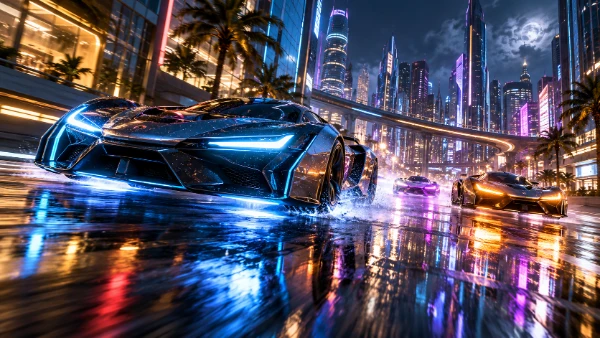
The visibility of ray tracing depends heavily on the environment. A wet street, polished floor, metallic vehicle or body of water gives a reflection system plenty of opportunities to show what it can do. A dark corridor with several moving light sources can make improved illumination or shadows similarly noticeable. Move into a dry outdoor area with mostly matte surfaces and uniform daylight, however, and the same ray-tracing setting may produce a much smaller visual change. This is why judging the feature from a single screenshot is unreliable. The same game can contain areas where the difference is clear and other areas where switching the setting on and off appears to change almost nothing.
Screen size also matters. A modern flagship phone may have a very sharp display, but it is still physically small compared with a monitor or television. Fine reflection errors, subtle shadow transitions and small changes in indirect lighting are harder to notice when the image occupies only a few inches. The situation changes when the player stops moving, examines a scene closely or compares identical frames side by side. During normal gameplay, however, movement, camera changes, particle effects, enemies and interface elements compete for attention. A graphical improvement can therefore be technically real without becoming an obvious part of every minute of play.
The type of game is equally important. A slow exploration game can give lighting time to become part of the atmosphere, while a competitive shooter may encourage the player to prioritise visibility and frame rate instead. Ray tracing therefore has no universal visual value that can be expressed by saying that it makes every Android game look noticeably better. Its usefulness depends on what is being rendered, how the developer applies it and how the game is actually played. By 2026, this is one of the clearest lessons from real mobile implementations: the quality of the effect matters more than the presence of a ray-tracing label in a phone’s specification.
What Real Android Games Show About Ray Tracing in 2026
War Thunder Mobile remains one of the clearest demonstrations because ray tracing is part of a complete commercial game rather than a standalone graphics test. Gaijin introduced hardware-accelerated ray tracing for supported Snapdragon hardware, initially highlighting improvements to shadows and related lighting behaviour. The feature has continued to receive attention in later game updates. A September 2026 technical update, for example, included fixes for display errors associated with the Ray Tracing setting as well as graphical improvements elsewhere in the Android version. That is significant because it shows that mobile ray tracing is being maintained as an active game feature years after its first appearance rather than existing only as a short-lived demonstration.
Its visual effect also demonstrates the limitations of judging mobile graphics by technology names alone. War Thunder Mobile contains large outdoor environments, vehicles, terrain, buildings, water and rapidly changing viewpoints. Ray-traced shadows can look more natural around vehicles and objects, particularly when the player deliberately looks for differences. During an active battle, however, the improvement can be much less prominent. Earlier real-device comparisons of the game found that the ray-traced version could be surprisingly difficult to distinguish from the conventional rendering during ordinary play. That does not mean the feature is ineffective. It means the existing rendering is already good enough that more accurate lighting often refines the picture rather than replacing it with something radically different.
Diablo Immortal provides a different example because its ray tracing focuses strongly on reflection quality. Google has documented how the game’s Android implementation uses Vulkan to take advantage of hardware ray-tracing capabilities on suitable mobile GPUs. Rather than relying entirely on information already visible on screen, the game can calculate more consistent reflections involving complex materials and objects. This can matter in an action RPG filled with environmental effects, glossy surfaces, liquids and rapidly moving characters. Even here, the most visible improvement is scene-dependent. Ray tracing may stand out around reflective areas while having much less influence on a section dominated by stone, vegetation or effects that do not depend heavily on accurate reflections.
War Thunder Mobile, Diablo Immortal and Arena Breakout Show Different Priorities
Arena Breakout illustrates a third approach. Tencent has publicly discussed using Vulkan Ray Query techniques for effects including reflections, ambient occlusion and soft shadows in the mobile game, with optimisation aimed at maintaining smooth performance on recent Android hardware. This matters because it demonstrates that developers do not have to treat ray tracing as one enormous graphics switch. They can choose individual effects where more accurate light calculations make the greatest difference and design those effects around the limits of a phone. That selective approach is likely to remain important because Android devices vary enormously in GPU speed, cooling, battery capacity and display resolution.
The three games also show why lists of “ray-tracing phones” can be misleading. A handset can contain a GPU with hardware ray-tracing support without automatically enabling every ray-traced game feature. The developer still has to implement the effect, optimise it for particular graphics architectures and decide which devices should receive the option. Game versions and device-specific compatibility rules can therefore matter just as much as the theoretical capability of the chip. A phone supporting hardware ray tracing at the GPU level should not be assumed to expose a Ray Tracing toggle in every compatible-looking Android game.
There is also a difference between support and practical quality. Qualcomm introduced hardware-accelerated ray tracing to its flagship Snapdragon range with the Snapdragon 8 Gen 2 and continued improving the capability in later generations. MediaTek has likewise promoted real-time ray-traced gaming on flagship Dimensity hardware, including the Dimensity 9300 generation. By 2026, the hardware itself is no longer the experimental part of the story. The more important variable is software. A carefully optimised reflection or shadow implementation in an actual game can provide more visible value than a powerful GPU running an effect that has little relevance to the scene. Real games are therefore a better measure of mobile ray tracing than theoretical throughput alone.
Is Ray Tracing Worth Enabling on an Android Phone in 2026?
For visual quality, the answer depends on the game and on what the player values. If a supported title uses ray tracing for reflections that are frequently visible, enabling it can improve scene consistency and remove some of the familiar limitations of conventional reflections. If it improves shadows, objects may sit more naturally within the environment because the shape and softness of the shadow respond more accurately to lighting. More advanced lighting implementations can improve the relationship between bright and dark parts of a scene. These are meaningful changes, but they are usually refinements rather than the kind of leap seen when moving from a very low graphics preset to the highest one.
Performance remains part of the decision. Calculating additional lighting information requires GPU work, and a phone has a limited thermal budget. The latest flagship chips have become considerably better at handling these workloads, and developers increasingly combine demanding effects with techniques such as resolution scaling, reconstruction and other rendering optimisations. Even so, a device that can produce excellent performance for several minutes is not necessarily able to maintain the same speed through a long gaming session. As the phone warms, its performance management can reduce clock speeds to control temperature. A ray-traced setting that looks perfectly practical in a short test may therefore have a different effect during an hour of continuous play.
Battery consumption deserves similar attention. A demanding GPU feature does not operate in isolation: display brightness, refresh rate, processor load, network activity and the game’s frame-rate target all contribute to energy use. War Thunder Mobile’s developers themselves recommend external cooling for users who want to play at the highest available graphics settings without an FPS limit, and the game’s 2026 updates include measures intended to reduce unnecessary heat and power use when lower frame-rate limits are selected. That is a useful reminder that the best graphics configuration is not automatically the one with every option at its maximum value. On a phone, image quality, sustained speed, heat and battery life are always connected.
When You Will Notice Ray Tracing and When It Is Better to Prioritise Frame Rate
Ray tracing is easiest to appreciate when playing a visually rich single-player or less time-sensitive section of a game on a high-end phone. Look for scenes containing water, polished materials, windows, metal, strong local lights or large moving shadows. Stop in the same location, keep the camera in roughly the same position and compare the setting both ways if the game allows it. Reflections should be checked not simply for brightness but for whether objects remain correctly represented as the camera moves. Shadows can be compared around their edges and where several objects overlap. This kind of observation gives a far better idea of what the technology contributes than a benchmark score.
There are equally valid situations where frame rate should receive more attention. Fast competitive games benefit from consistent animation and responsive controls, and a visual effect becomes less attractive if enabling it creates noticeable frame-time instability or makes the phone uncomfortable to hold. The same applies on devices that sit near the lower end of a game’s supported ray-tracing hardware. Reducing a demanding lighting option may allow a higher or more stable frame rate, a higher internal resolution or a longer session before thermal limits become noticeable. Players should therefore treat ray tracing as one graphics option among several rather than assuming that it must always be enabled on a capable device.
By 2026, mobile ray tracing is real, usable and increasingly mature, but its greatest achievement is subtler than the early marketing around the technology suggested. War Thunder Mobile shows that ray-traced shadows can run inside a large, fully playable Android game. Diablo Immortal demonstrates practical hardware-traced reflections through Vulkan. Arena Breakout shows how developers can apply ray-based effects selectively while targeting smooth mobile performance. In all three cases, the important improvement is better treatment of specific lighting problems rather than an entirely new appearance for every scene. On current flagship Android hardware, ray tracing can make games look better, and there are moments when the difference is easy to see. There are also many moments when a player concentrating on the game may barely notice it. That distinction is precisely why real gameplay, rather than a benchmark result, is the most useful test of mobile ray tracing in 2026.